Trace Elements: Essential or Not Essential?
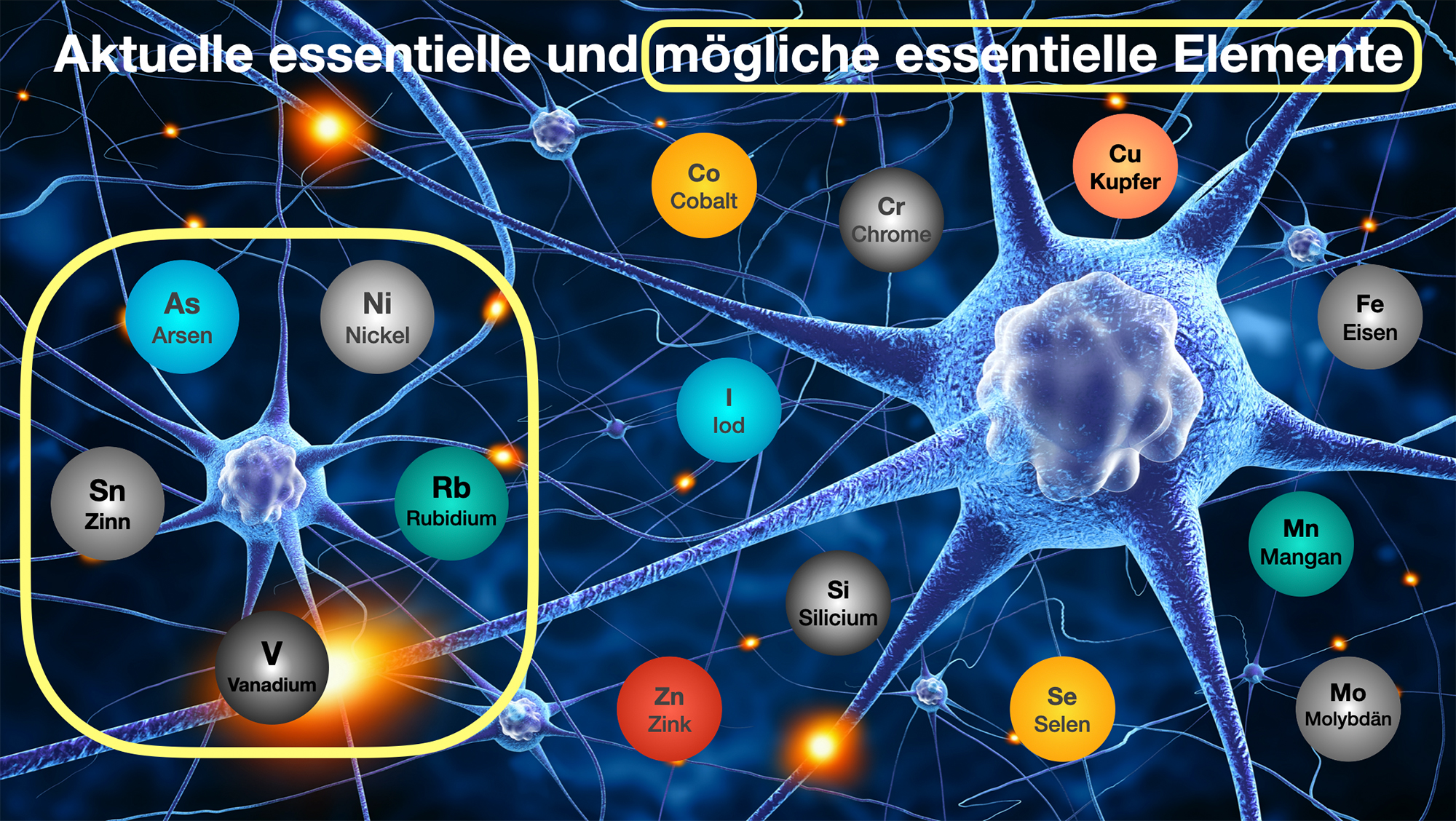
Who decides which trace elements are essential, possibly essential, and not essential for us?
Humans need trace elements to stay healthy – they are therefore essential for their survival. Over time, the list of these chemical elements has changed repeatedly. But is the decision about what is good and necessary for us about our health and an optimal metabolism? We have 81 stable chemical elements on Earth in varying amounts. Is not every element of them essential? It is all just a question of quantity or “the dose makes the poison”. This also applies to salt, by the way, which is very healthy, but at 0.5 kg per day has harmful to lethal effects!
Note: Too much salt is healthier than too little salt, as was propagated for years and is still partly recommended today. Eating salt-rich is healthy! The study with the results that are still cited today has nothing to do with biology or natural eating/instincts. The study is supposed to prove that too much salt is not healthy and can lead to increased cardiovascular diseases up to death. The salt consumption that was force-fed to the poor animals amounted, converted to humans, to 0.5 kg of salt per day – this can rather be described as stuffing salt and only shows how often studies and propaganda interact and function.
The current list of essential trace elements (as of 2020)
• Chromium (Cr)
• Cobalt (Co)
• Iron (Fe)
• Iodine (I)
• Copper (Cu)
• Manganese (Mn)
• Molybdenum (Mo)
• Selenium (Se)
• Silicon (Si)
• Zinc (Zn)
An overview of all elements of the periodic table can be found with much information and sorting sequences at Lenntech.de
The following trace elements are on an “observation list” and have been selected as possibly essential trace elements:
• Arsenic (As)
• Nickel (Ni)
• Rubidium (Rb)
• Tin (Sn)
• Vanadium (V)
Note:
The element selenium was originally not essential, although studies since the 1960s to 1970s had shown its positive benefits and diverse effects in our metabolism. It took about 30 years, after studies were already available, until selenium was officially declared essential! A remarkable achievement of our experts or rather lobbyists?
How long can or do we want to wait until all 81 elements have been analyzed to decide which elements are essential and which are not, in order to reintegrate the essential trace elements into our food cycle?
What is the difference between bulk minerals, trace elements and ultratrace elements?
Bulk Minerals
In the case of macro elements, at least 50 mg per 1 kg body weight are present in the body. The macro elements include sodium, potassium, calcium, magnesium and phosphorus.
Trace Elements:
must be ingested in “small traces”, that is in small amounts through food, to enable the flawless functioning of our complex metabolism. Trace elements occur in concentrations of <100 ppm or 100 µg/kg or 0.01 % by weight in the organism. The essential trace elements include iron, iodine, chromium, copper, zinc and selenium.
Ultratrace Elements
occur in even much smaller amounts than trace elements, but are equally vital for our metabolism: Ultratrace elements occur in concentrations of less than 1 ppm = 1 µg/g or 0.0001 % by weight in the organism. The ultratrace elements include cobalt, lithium, strontium, boron and antimony.
Another Note on Quantities in Food Supplements
A distinction must always be made between the amount of a compound and the amount of the pure element.
Example Lithium Orotate as a tablet (is a compound) Lithium with 5 mg per tablet: Lithium is present as the compound lithium orotate. Each tablet with 131 mg contains 5 mg of pure lithium.
Interesting Studies
Study on Lithium: Lithium in Drinking Water and the Incidences of Crimes, Suicides and Arrests Related to Drug Addictions Source: Pubmed here: https://pubmed.ncbi.nlm.nih.gov/1699579/ Study from 1990
Study on Selenium, Results in Secondary Diseases: Effects of selenium supplementation for cancer prevention in patients with carcinoma of the skin. A randomized controlled trial. Nutritional Prevention of Cancer Study Group Source: Pubmed: https://pubmed.ncbi.nlm.nih.gov/8971064/ Study from 1996