Electrolysis Does Not Produce Colloidal Metals
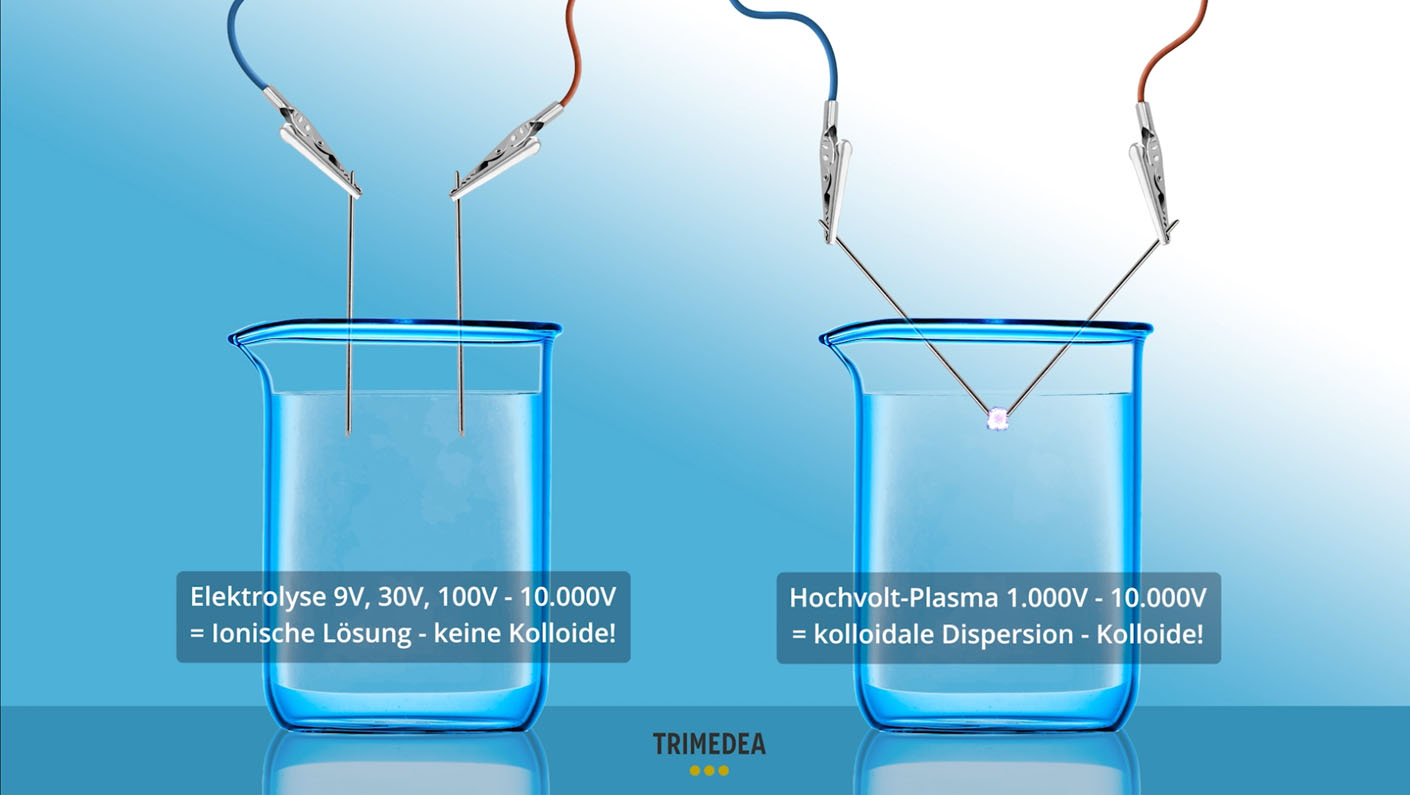
Clarification: Ionic Solutions Do Not Act Like Colloidal Dispersions
As there is a lot of contradictory information on the production of colloidal metals, we would like to contribute a little to clarification. Learn more here about the differences between the two manufacturing processes electrolysis and high-voltage plasma. Since the manufacturing process has a significant influence on the effects, actions, possible risks and side effects, it is important to inform yourself precisely and understand in detail what exactly happens and is produced in each process.
Electrolysis: Ionic Solutions Act Quite Differently on Our Body
The effects of ionic silver (silver water) or colloidal silver (silver colloids) are very different in the body. This also applies to all other metals.
When electrically charged and reactive silver ions enter the body, these silver ions react immediately and form compounds with the substances present. First points of contact are the oral mucosa, saliva or, after swallowing, stomach acid. Silver ions and chloride lead to the formation of silver chloride, which is not entirely unproblematic for the body. Silver ions and chloride ions attract each other very strongly and form a unit/connection that is no longer soluble for the body.
When taking high concentrations (50 to 100 ppm) over a longer period, it can lead to blue discolouration of the skin, which is often cited as a negative example for colloidal silver. However, ionic silver (electrolysis) has nothing at all to do with colloidal silver (high-voltage plasma).
The reactivity of the metal ions applies to all metals – regardless of whether silver, gold, platinum, germanium, silicon, copper, zinc, etc.
The high-voltage plasma process explained briefly:
High-Voltage Plasma Process: Real Colloids Do Not Accumulate in the Body
In contrast to the silver ions produced by electrolysis, the high-voltage plasma process produces real silver colloids (very small silver particles) that do not form compounds with other substances such as oral mucosa, saliva or stomach acid. These silver colloids (= colloidal silver) do not accumulate in the body, but are excreted again when the body no longer derives any benefit from the colloids in its metabolism.
The small colloids of the various metals supply the body with metal particles (colloids), as well as a metal-specific vibration that acts energetically-informatively in the body.
More information and details on the differences between electrolysis and the high-voltage plasma process can be found here.