Drinking Water Measurement Value: How Clean Is the Water in Your Pipes?
What You Should Know About Water Quality, Conductivity and Drinking Water Filtration
Various methods exist for analyzing drinking water quality, such as conductivity measurement, simple or complex laboratory tests, or spectral analyses. In the private sector, conductivity measurement is used most frequently. The unit of measurement is microsiemens (μS). This value measures the electrically conductive elements and particles in the water (ions) and provides a quick but only approximate indication of water quality. Measuring devices also display parts per million (ppm). The units ppm and μS can be converted easily: 1 ppm corresponds to approximately 2 μS. Thus ≤ 10 ppm corresponds to approximately 20 μS. Doubling the ppm value therefore yields roughly the value in μS. Because metals/minerals and their ions in the water increase the value considerably, water with high levels of metals/minerals also has a much higher value than water with lower levels of metals/minerals. Whether the minerals promoted as healthy in water are usable and beneficial in our metabolism can be read in a separate article here.
Electrically neutral particles cannot be detected with the microsiemens measurement value. Electrically neutral substances or compounds such as certain hormones, pesticides, fungicides or medication residues can only be identified and quantified in a chemical laboratory analysis. Whether with or without chemical analysis: sediment and activated carbon filters always remove only some of the undesirable substances present in the water, whereas reverse osmosis filters safely remove up to 99 % of undesirable substances – which is desirable when producing drinking water.
The standard values have changed significantly over the years. But as is often the case from a biological-health perspective, not to our advantage: Because water utilities are having increasing difficulty removing the diverse pollutants from the water and ensuring high drinking water quality under economic conditions, they resort to questionable strategies to be able to claim “visually” better quality:
• Raising the measurement values: In 1990 the measurement value in Germany was 1,000 μS; by 2011 it had already reached 2,790 μS – an increase of 279 %
• Use of chlorine, ozone or UV light for germ killing: Dead germs or their toxic metabolic degradation products during the decomposition process in the water are not removed
• Selective choice of the pollutants to be analyzed: Usually at most 50 of the estimated more than 30,000 pollutants in the environment and thus in the water cycle
• Extensive marketing with the claim that our drinking water is clean and high-quality
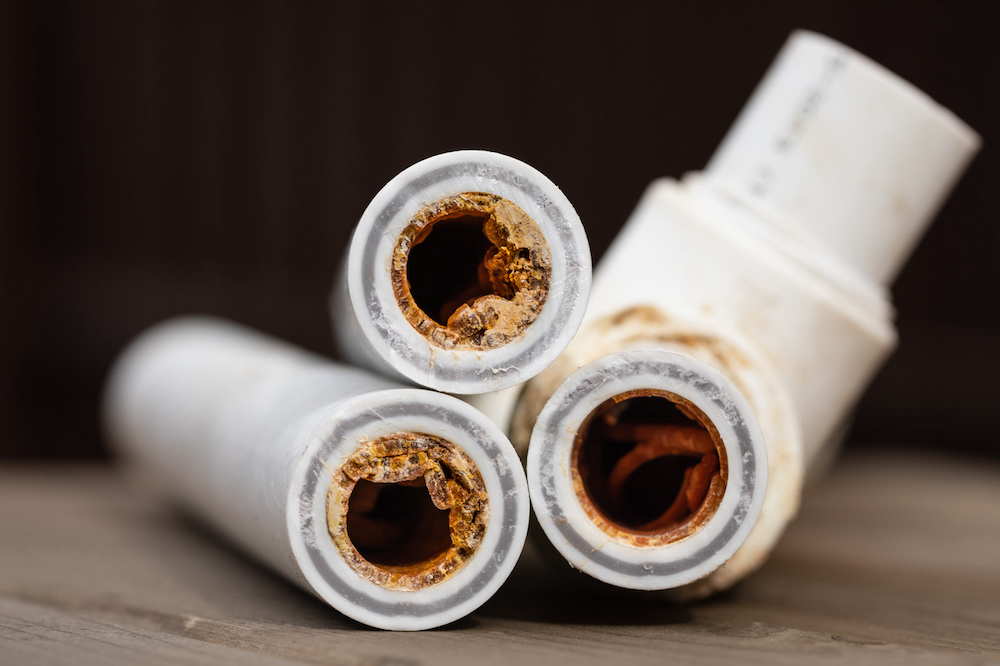
From purely logical considerations it appears nonsensical that the water utilities should already purify the delivered water to drinking water level. Because the largest share is used for toilets, washing machines, dishwashers, etc., which therefore does not need to be of drinking water quality. In addition, the sometimes very old long pipes and water lines up to the domestic tap release countless substances into the possibly previously “purified” water. An analysis at the water utility with a good measurement value does not mean that this quality also arrives and is measurable at home at the tap.
A simple measurement without in-depth chemical laboratory analysis already reveals a great deal:
• Biologically good and healthy water has a measurement value of at most 130 μS
• Very good water that also deserves the name pure and healthy drinking water has values between 30 and 90 μS
• Even after reverse osmosis filtration the conductivity value is not 0, because the reverse osmosis membranes remove various substances from the water at rates of 90 % to 99 % (depending on the type)
The incoming water quality (municipal water) has a direct influence on the values (electrical conductivity) after reverse osmosis filtration.
Examples:
• Municipal water value: 250 μS. After reverse osmosis filtration: values of 2 to 25 μS (very pure water)
• Municipal water value: 750 μS. After reverse osmosis filtration: values of 7.5 to 75 μS (very pure water)
• Municipal water value: 1500 μS. After reverse osmosis filtration: values of 15 to 120 μS (very pure to good water)
Separation of drinking water and service water: a worthwhile investment
Perhaps we consumers should divide the topic of water and water quality into service water and drinking water and apply the respective proven technologies according to economic efficiency. Especially in new house construction, intelligent and future-proof solutions can be implemented in this way. This would mean, for example, that a whole-house water filtration system is installed at the house entrance after the water meter/backwash filter, which removes dirt, dissolved substances such as sand, rust, but also many other health-concerning substances from the entire house water and thereby also protects the entire water pipe system including connected appliances. Sediment filters of varying fineness and activated carbon block filters are suitable here. They remove many health-concerning substances – toilet, washing machine and shower are thus supplied with clean water and water lines are protected.
Also note the required flow rate of the whole-house filtration system (liters/minute). With too low a capacity you run the risk that water will only drip out when water is used simultaneously from several taps. Replacement of the filter elements takes place every 3 to 6 months depending on incoming water quality and pressure control.
Advantage: For drinking water the reverse osmosis module in the kitchen is sufficient
For drinking water filtration a space-saving reverse osmosis module can be installed in the kitchen that requires no pump, tank or electrical parts. Because pre-filtration is already provided by the whole-house filtration in the main water line, the reverse osmosis module under the sink in the kitchen is sufficient. If needed, a sediment filter (1 μm) can be placed before the reverse osmosis unit to safely remove constantly released suspended particles in older house pipes.
Anyone who also considers the topic of water activation (UMH water activation) with this setup should then have optimal water available from the tap in their house from a chemical, biological and biophysiological perspective.
Solutions from Aqua Naturalis
With the company Aqua Naturalis, we have compiled various drinking water filter sets for different requirements. Starting from an ultrafiltration up to modular osmosis filters that can be expanded later to increase the amount of water produced per minute (l/min).
• Water filter system with UMH water activation: AQUNA Osmose Light mains-free
• Central water filter system for the water in the entire house with UMH drinking water activation (basement + kitchen): AQUNA Standard mains-free